
Former President Donald Trump has always been known for his big statements at his rallies. His recent push to eliminate the Department of Education is no exception. However, as with many of Trump’s proposals, this one has sparked a heated debate. Depending on where you get your news, you might see it framed as a long-overdue conservative victory or a logistical nightmare. In this post, I’ll break down how three major outlets, The Washington Post, Fox News, and CNN, are talking about the former president’s proposal and what it means for the future of education in America.
The Washington Post: Full of Contradictions?
In The Washington Post‘s coverage, titled “Trump drives the education debate with big, contradictory ideas,” they don’t hold back from calling out the contradictions in Trump’s agenda. They argue that while Trump wants to eliminate the Department of Education to cut federal oversight, he also promises to enforce stricter control over school curricula. However, this task would require federal involvement. The Washington Post questions whether it’s even feasible for Trump to follow through on such promises without the support of Congress, suggesting that his plan is more symbolic than realistic.
“Trump wants to close the Education Department and send education ‘back to the states,’ but he also wants Washington to oversee what is taught in individual schools—something the federal government has never done.”
Laura Meckler
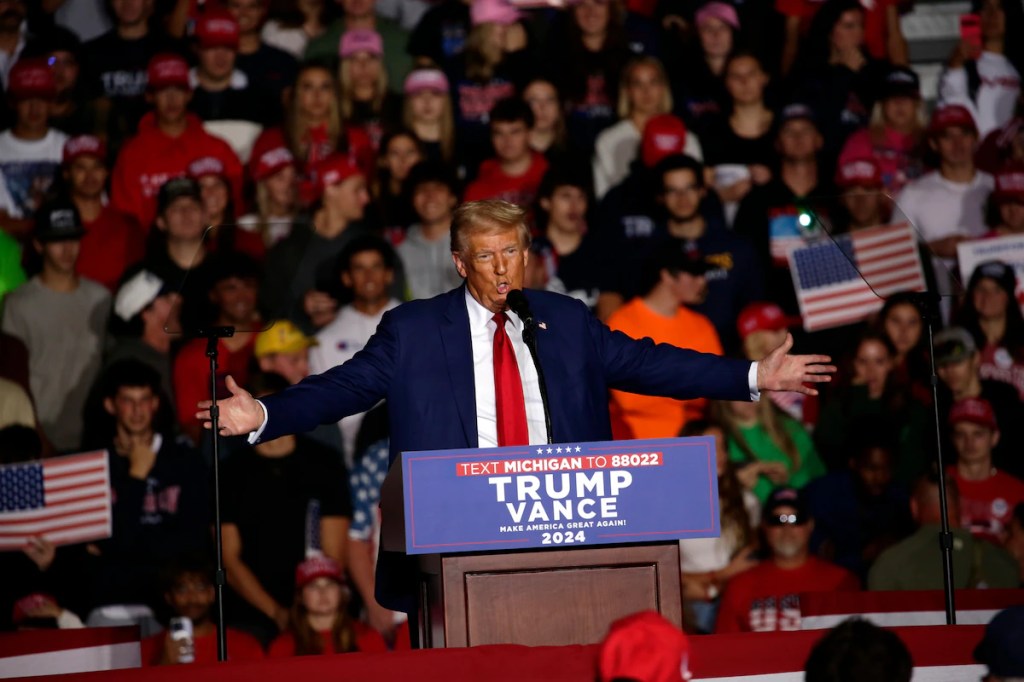
The imagery used in The Washington Post plays a crucial role in shaping readers’ perceptions. One photo shows a group of Winnemucca Republicans gathered in a Nevada wine bar, watching a debate between Trump and Harris. In this image, Trump is captured with an upset expression, while Harris appears calm and composed. This visual contrast subtly positions Harris more favorably. They use another close-up of Harris addressing voters at a Wisconsin rally, portraying her as polished and professional, further emphasizing her authority. Additionally, the article features a less flattering image of Trump at a rally, mid-speech, which doesn’t capture him in his best light and supports the article’s more critical tone.
Fox News: Momentum Builds for Trump’s Proposal
Meanwhile, Fox News takes a much more optimistic approach in its article “Trump push to dismantle Education Department met with enthusiasm in House GOP.” The focus here is on the growing support for Trump’s plan within the GOP. They frame the proposal as part of a broader conservative effort to return education control to the states and remove federal bureaucracy. The article downplays the logistical challenges, instead highlighting the enthusiasm among Republicans for finally achieving a goal that has been around since the Reagan era.
“Massie said he was ‘pleasantly surprised’ to hear Trump support such an effort, signaling that dismantling the Department of Education could be a real possibility if Republicans win in November.”
Elizabeth Elkind

Fox News‘s language is more positive and uses more action-oriented words like “momentum,” “enthusiasm,” and “support.” By using words that convey energy and optimism, Fox News cultivates a sense of forward movement and progress, encouraging readers to view the plan favorably. It reinforces the idea that Trump’s proposal is gaining traction and paints it as an achievable goal.
CNN: The Practical Realities
CNN takes a more practical, neutral stance: “Trump wants to shut down the Department of Education. Here’s what that could mean.” The article outlines the Department of Education’s key roles, such as administering federal funds to low-income schools and enforcing civil rights protections. CNN points out that dismantling the DOE wouldn’t be easy, requiring congressional approval and likely disrupting programs that support millions of students. They also raise the question of what happens to the $1.6 trillion student loan portfolio if the department is eliminated.
CNN employs neutral, factual language to present the issue in a straightforward manner. Words like “administer” and “manage” highlight the operational and bureaucratic nature of the DOE’s role, avoiding emotionally charged words. This deliberate use of neutral language makes this article more objective, positioning it as focused on the concrete impacts of the proposal rather than engaging in political rhetoric.
“The Department of Education’s biggest tasks include distributing $28 billion annually to K-12 schools and managing $1.6 trillion in student loans.”
Katie Lobosco

Erin Scott/Bloomberg/Getty
In keeping with CNN‘s factual tone, the article uses a neutral image of the Department of Education building. There’s no emotional framing or political figures here—just a straightforward depiction of the institution that could soon be at risk, which aligns with the article’s focus on practical outcomes.
Why It Matters
Each outlet frames Trump’s proposal to reflect their broader editorial stance. The Washington Post sees it as a contradictory and politically risky move, Fox News paints it as a long-awaited conservative victory, and CNN focuses on the practical realities of dismantling a major federal department. This diversity in media framing highlights how the same issue can be presented in vastly different ways, shaping how readers understand and feel about the news. The imagery used by each outlet is also a key part of how the story is framed visually, influencing readers’ emotional responses. Everything these outlets choose to do, how they say it, and which pictures they choose have been done purposefully and with a goal in mind. As you follow this story, consider how the media you consume frames the issue—and don’t be afraid to dig deeper.
References
Meckler, L. (2024, October 10). Trump drives the education debate with big, contradictory ideas. The Washington Post. Link
Elkind, E. (2024, August 14). Trump push to dismantle Education Department met with enthusiasm in House GOP. Fox News. Link
Lobosco, K. (2024, September 20). Trump wants to shut down the Department of Education. Here’s what that could mean. CNN. Link
One response to “Education on the Line: The Impacts of Trump’s Plan to Eliminate the DOE”
-
[…] choice of Linda McMahon as Secretary of Education. This blog serves as a follow-up to my earlier blog post on Trump’s plans to eliminate the Department of Education, delving into the nomination of McMahon […]
LikeLike
 Teach IT: Tech and Teaching Innovations in Education
Leave a comment